
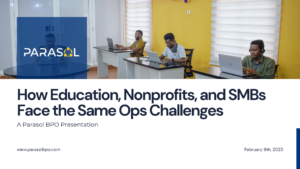
At first glance, schools, nonprofit organizations, and small-to-medium businesses (SMBs) may seem to operate in entirely different worlds. One focuses on learning, another on social impact, and the third on profitability. Yet behind the scenes, they often struggle with the same operational challenges that limit growth, efficiency, and long-term sustainability.
Regardless of mission or industry, these organizations depend on strong systems, reliable processes, and capable teams to function effectively. When those elements are weak, performance suffers.
Limited Resources, Expanding Responsibilities
One of the most common challenges across education, nonprofits, and SMBs is operating with limited resources. Budgets are tight. Staffing is lean. Technology investments are often postponed.
At the same time, expectations continue to rise. Schools are asked to deliver modern learning experiences. Nonprofits are expected to increase transparency and reach more beneficiaries. SMBs are pressured to compete with larger, better-funded competitors.
As a result, small teams are forced to manage growing workloads without proportional support. Staff members wear multiple hats, leading to fatigue, reduced focus, and declining productivity.
Overreliance on Manual Processes
Many organizations in these sectors still rely heavily on spreadsheets, paper records, and disconnected tools to manage operations. Student data, donor records, customer information, and financial reports are often stored in separate systems that do not communicate with each other.
This fragmentation creates inefficiencies. Simple tasks take longer than necessary. Errors become more frequent. Decision-makers struggle to access accurate, real-time information.
Without integrated systems, leaders are forced to operate reactively instead of strategically.
Administrative Burden on Core Talent
Teachers, program managers, and business owners are hired for their expertise, not for paperwork. Yet in many organizations, these professionals spend a significant portion of their time on administrative work.
Educators manage reports and compliance documents. Nonprofit leaders track grants and donor communication. SMB founders handle payroll, scheduling, and customer records.
When skilled talent is consumed by routine tasks, innovation slows and service quality declines. The organization loses valuable time that could be invested in growth and impact.
Inconsistent Processes and Workflows
Another shared challenge is the lack of standardized workflows. Many organizations grow organically, adding processes as problems arise rather than designing them intentionally.
Over time, this leads to inconsistency. Different departments follow different procedures. Tasks are completed based on personal habits instead of best practices. New staff members struggle to adapt because systems are undocumented or unclear.
Without clear workflows, efficiency becomes dependent on individuals rather than structures, creating risk when key employees leave.
Difficulty Scaling Operations
Growth is often seen as a positive milestone, but it introduces new operational pressures. More students, beneficiaries, or customers mean more data, more communication, and more coordination.
Unfortunately, many organizations attempt to scale using the same systems they used at a smaller size. What once worked for ten employees now struggles with fifty. What supported one location cannot support five.
This mismatch leads to bottlenecks, delayed services, and frustrated stakeholders.
Compliance and Reporting Pressures
Education institutions, nonprofits, and SMBs all operate within regulatory frameworks. Schools must meet accreditation standards. Nonprofits face strict reporting requirements. SMBs must comply with tax and labor regulations.
Managing compliance manually increases the risk of missed deadlines, inaccurate filings, and reputational damage. It also diverts attention away from strategic priorities.
Without proper operational support, compliance becomes a constant source of stress.
Technology Gaps and Adoption Barriers
While digital tools can solve many operational problems, adoption remains a challenge. Limited budgets, lack of training, and resistance to change often slow down implementation.
Some organizations invest in software but fail to integrate it properly. Others avoid technology altogether, fearing complexity.
As a result, they fall behind competitors and peers who leverage automation and data to improve performance.
The Case for Smarter Operations
Despite their differences, education providers, nonprofits, and SMBs share one reality: strong operations are essential to fulfilling their missions.
Efficient systems enable schools to focus on learning outcomes. They help nonprofits maximize social impact. They allow businesses to serve customers and remain competitive.
Improving operations does not require massive restructuring. It starts with identifying inefficiencies, standardizing workflows, adopting the right tools, and ensuring that skilled professionals spend time on high-value work.
How Strategic Support Makes a Difference
Organizations that thrive are those that recognize operations as a strategic function, not just a back-office necessity. By leveraging external expertise, automation, and process optimization, they create stability and scalability.
Business process outsourcing and operational support services can play a critical role in this transformation. From data management and customer support to finance and administrative services, structured support allows internal teams to focus on what matters most.
At Parasol BPO, we work with education providers, nonprofits, and SMBs to strengthen their operational foundations. Our goal is simple: reduce complexity, improve efficiency, and enable sustainable growth.
Conclusion
Education institutions, nonprofits, and SMBs may pursue different goals, but they face remarkably similar operational challenges. Limited resources, manual processes, administrative overload, and scaling difficulties affect them all.
Organizations that address these challenges proactively position themselves for long-term success. By investing in smarter systems and strategic support, they create the capacity to grow, adapt, and deliver greater value to their communities.
Strong operations are not a luxury. They are the backbone of lasting impact.
Book your Free Consultation today.
#BusinessOperations #ParasolBPO #SmartScaling, #OperationalExcellence, #BusinessSupport #NonprofitManagement #EducationLeadership #SMBGrowth #ProcessImprovement #WorkSmarter #TeamEfficiency #BusinessSolutions #OutsourcingSupport #SustainableGrowth